Showing posts with label battery formula. Show all posts

Tuesday, April 25, 2017

about 6F22

i was wasting some half a day to find out the max. safe discharge current rate for carbon zinc type
there was no such data avail.
-- so i had to make a best guess about

a fuzzy logic follows ::


it is statistical nonsense but since i had no other data avail than GP-s datasheet then what it seems / was assumed is that the average drain over longer time is somewhat constant . . .

. . . so if you want to design an application that uses 9V C-Zn battery then something optimal value is 12mA or below -- that is -- if it is to work 24/7

( it is amazing that we don't have that value available -- if you overload the battery it gonna heat up that first boosts the chemical reaction but likely roughly over 40°C (104°F) it starts to damage internal chemistry further on there might be acid or alkaline leak or explosion or even fire when Li-ion gets in contact with oxygen -- so all such totally insignificant stuff no one needs to know exactly -- especially the EE app. designers )


[Eop]

Wednesday, January 28, 2015

father (Darth Sidious ;p) asked a "Stupid Question"

as why the automotive cellphone charger finishes much quicker than the wall supply
heres what i came up with (though i'm not so shure about it)

Simplified Battery Charging

related formulas ::
(*) -- ! not proven !
E(J) = Q(A·h)·ε(V)
ΔE = dt·P(W)
ΔQ = I·t
dQ(A·s) = dt(s)·I(A)
ε = a·rb = E/Q
Δε = a·Δ(rb) = Δ(E/Q)
P = U²/r = I²·r

α²Q - αE = 0
(Q/QMAX)² - (E/EMAX) = 0
(Q/QMAX)² = E/EMAX (*)
Q² = Q²MAX/EMAX(=ϰ) ·E
E/Q = Q/ϰ
ε = a·rb
r = (ε/a)1/b
(E=)Q²/ϰ - Q·ε(=E) = 0
Q/ϰ - ε = 0
E = √(ϰ·E)'·ε
√(E/ϰ)' - ε = 0
E = Q·ε
ε = E/Q =  Q/ϰ
ε = u + U = i·r + U
εTF = i·rTF + U
ε℩B = i·r℩B + U
εTF - i·rTF = ε℩B - i·r℩B
εTF - ε℩B = i·( i·rTF - i·r℩B)
i = ΔεX/ΔrX
[EoP]


Friday, January 24, 2014

about AA or LR6

i used to believe that the battery capacity is not been near entirely used (by random application) so i  a bit "wasted my time" on studding 'em // -- as in fact it turns out the battery keeps it's output "Up" for up to 90% of it's capacity

the processes present at exploitation (not discussed further in this article - just listed)::

0) internal electro mechanics and electrical field set up by load current and env. temperature
1) reduction of the chemistry induced charge
2) chemistry change by discharge
3) re-inducing the charge by present chemistry

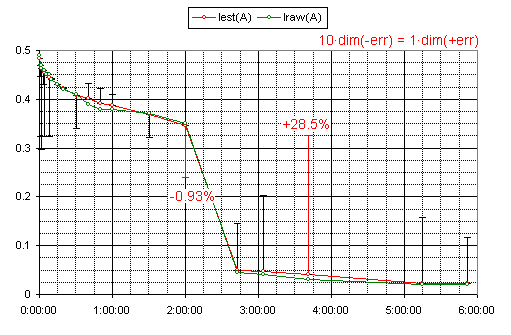
i made the series of simple discharge v. time tests
the values for internal resistance and electro-motoric force are derived theoretically(1)

notice! that the experiment recorded just terminal voltage and current levels -- everything else is derived

the legend explained::

C836mAh(%) -- the percentage of "full capacity" -- 836mAh in this case
iC -- 1 (100%) minus C836mAh(%)
E -- electro-motoric force in volts
r20Ω(%) -- internal resistance / 20Ω
Iest(A) -- estimated terminal current in amperes
P(W) --U x I -- external- / diffusing power
Csimple(%) -- R.const C battery alternate (as using capacitor + delimiting resistor inplace of an alkaline)

about the error of the used theoretical model(1)

i speculate that the master fluctuations are due error in device redings -- whatever the case it's not so significant

the E(r) or r(E) dependency(1) is defined from measuring multiple AA cells at their various discharge levels


notice! that there's no time dependency defined

[EOF]