Showing posts with label AAA. Show all posts

Monday, January 8, 2018

Regulated single 1.5V AA Led Flaser Concept


there are different 2N3904 models the ones with 100mA I.F and the ones with 150mA I.F -- in REAL implementation of this circuit you may need to multiple parallel these for a switching transistor or use a more powerful low U.CE type one


PS! this is a simulation experiment - the real circuit and components for a similar output parameters may somewhat or significantly differ of those shown in the fig. !!!

about & how we got ↑there↑ ::

initial circuit
the op amp regulation promises worse results than the transistor regulation on the first figure

[Eop]

Thursday, December 18, 2014

1.2V Emergency Light Revisited

i've built several of these bullsh¡t -- the only one that seems to function fine not been taken back appart to spares -- it goes from 1 AAA about 24h , perhaps more , then simultaneously restarts at low battery after being "mute" at some 36h after initial 24+h time of operation , then it works barely visible next 24+h - - i guess (for obvious reasons i haven't just sat and watched what it exactly does) -- the grid :: (R2 here is to match the BC847 to a real KT315 ) the measured operational data :: avg. 1.4415V (40...50 assume) 47mA @ input terminals , avg. 5585mV(28.5...28.7mV @ 10.3Ω res. = ) 2.7767mA @ "High" voltage terminals - gives us apx. 22.3% efficiency in NRG2NRG and 11.2% efficiency in NRG2Light --- the blue light being well detectable gives here the effect of "successful" design (& sh¡t ...)                 ... so revisited v. :: ◄ that thing matches the real "GO" better than the previous simulation -- apx. measured / derived operational data :: 1.472V ~47mA @ input terminals , 8.37V 4.59mA @ "High" voltage terminals - gives us apx. 55.5% efficiency in NRG2NRG and 27.8% efficiency in NRG2Light --- there is no experimental data yet about the responce to an input power variation (just wanted to verify such works)

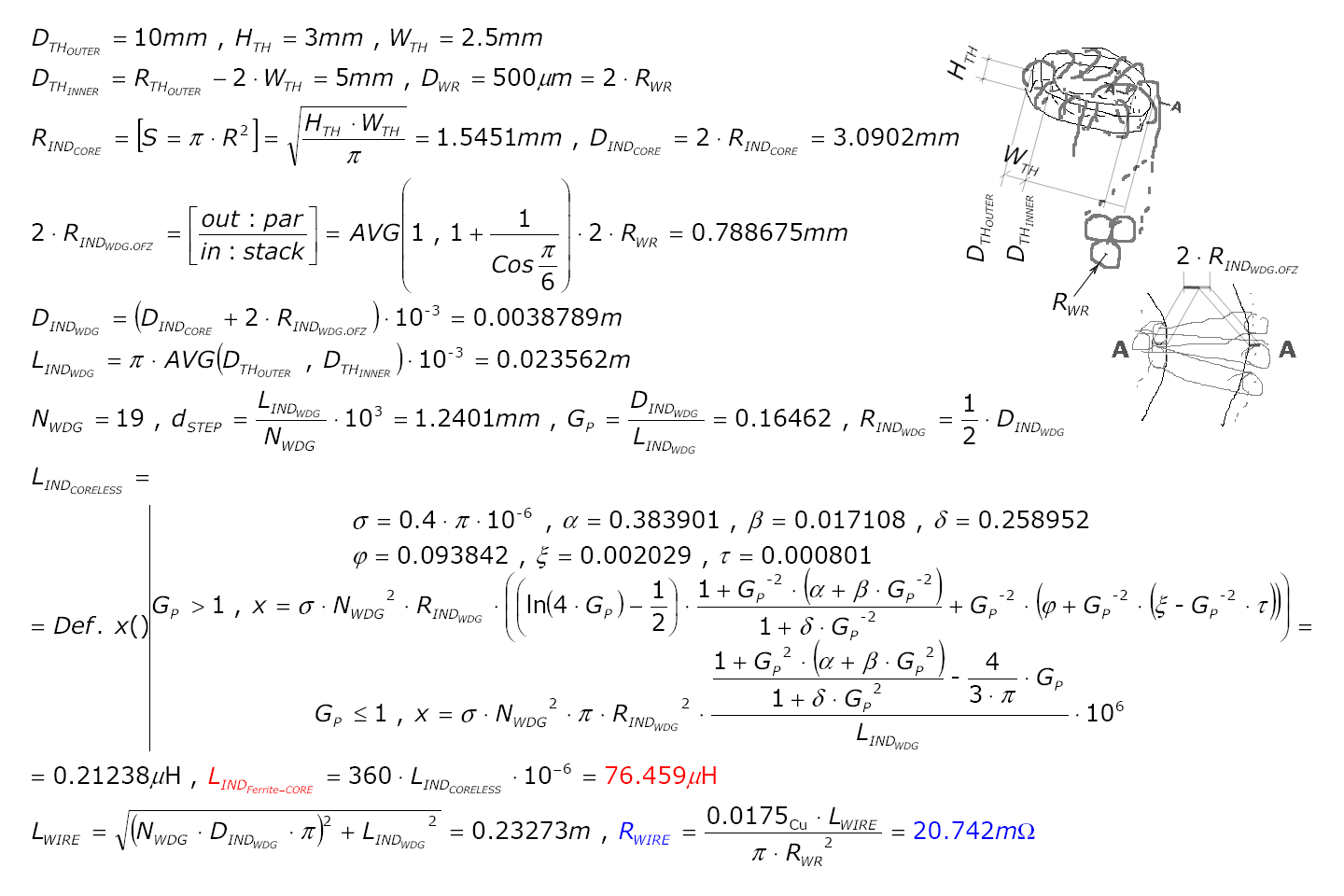
Confirming that the "guess" value used for inductor in the last DC-DC converter does not fall too far from the actual 1 ... ◄ about
xSpiceComputed-!- Error
Inductance60µH76µH68µH ± 12%
Resistance980mΩ*
(39mΩ)
21mΩ30mΩ ± 30%


* -- assumed / defaulted to - diameter 0.1mm* (corrected for 0.5mm)
-!- -- the error is given so because there's no data about the real values (should be derived experimentally)

some changes :: ... usually there's not enough power to push the power transistor ...

(Added 2015-01-10) LTSpice Src ...

[EoF]

Wednesday, March 5, 2014

about AAA or LR03

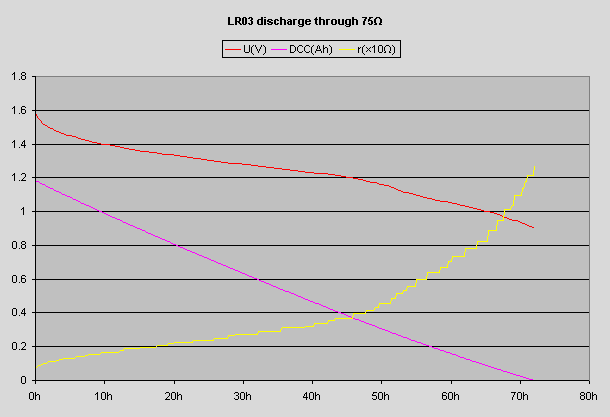
for obvious reasons i didn't want to run the tests myself so i relied on THIS - likely the only thing the Google can currently allocate - suitable for this purpose

a bit processing ::


and we have some fuzzy insights based on my own LR03 stats. - based on 60 AAA-s @ various discharge using ε(r) relation ::


Load
(Ω)
dt
(s)
Eε(U)
(V)
Er
(Ω)
I
(mA)
ΔC
(mA·h)
3.923.41.49(1.11)1.31285735
5.132.51.47(1.14)1.44224876
201321.32(1.14)3.2256.91058
241941.37(1.25)2.3452.21025
756191.29(1.23)4.0716.31180
note: the prefix E is used for Expected value in probability theory -
such as EX = Σ(xi·pi) = [here assuming all pi = 1/n] = 1/n·Σ(xi) , /!\ /!\ /!\
Load
(Ω)
FreshExhausted
ε(U)
(V)
r
(Ω)
I
(mA)
ε(U)
(V)
r
(Ω)
I
(mA)
3.91.69*(1.49)0.5333811.38(.902)2.07231
5.11.67*(1.5)0.5732941.34(.907)2.46178
201.57(1.5)0.8875.11.17(.901)6.0945
241.62(1.57)0.7165.51.21(.998)5.0741.6
751.6(1.57)0.771211.05(.902)12.712

reprocessed web LR03 stats. ::
* -- /!\The source site refers their device falling into initial EMF range of 1.58...1.65V - since the corresponding values for 3.9 and 5.1 Ω tests exceed the range it must be assumed that the test resistance used was of the inappropriate power range e.g. it's resistance significantly increased during the beginning of the test due thermal effects . Since there would be two unknowns to find and match to process time at all times i won't provide the appropriate corrections here. I suggest the graphs being more adequate at the end of tests.
update : as i always post-error-check my ramblings (((a programmers special disease :: the prog-s're huge - the 'puter responce is always at some extent unpredictable - so it makes more sense to write your code - then multiple pass dis-errorize it - you can't avoid unknown error conditions in advance - even if there's no programmatic (code-flow) errors - you should still verify it does what it suppose to e.c e.c))) - so the update - it seems the QC passed a quite common 1 "a sign error" - it appares the higher the TEST resistance the higher the EMF(electro-motoric force for the battery (we need it actually to be lower here)) - /!\ there is actually such intermediate term phenomena as the more current is drawn from battery the better it performs (the higher the EMF temporarily climbs) - which might explain the higer startup EMF for lower resistance TESTs - i must make tests of my own to verify such -- for NOW what is known is that if we /!\ /!\ ALTER the "battery formula" ε = 1.5371 r-0.1493 >> ε = 1.25 r-0.5 then it'll show better correlation for that very dependency throughout the different TESTs . . . /!\ yes ? - should it ...
/!\

NB! -- this is just apx. guide line -- there is no any real instance of LR03 presented on those graphs
PS! -- notice that the unit for the internal resistance here is not the conventional and is varying by graph.